
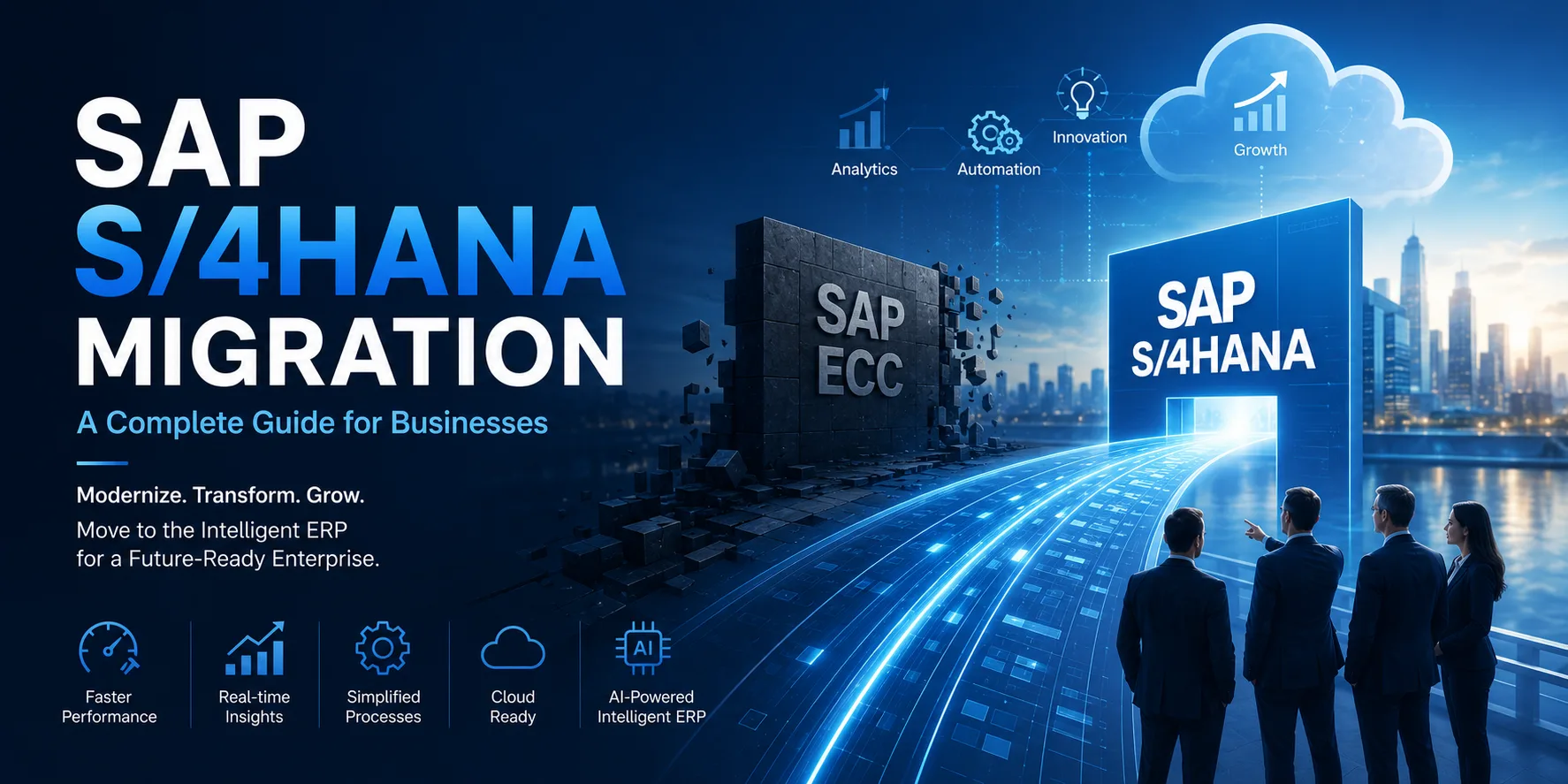
ERP modernization has moved from a long-term IT roadmap item to an immediate business priority for most SAP customers. At the center of that shift sits SAP S/4HANA migration, the process of moving from SAP ECC to SAP’s next-generation ERP platform. SAP has confirmed that mainstream maintenance for SAP ECC will end on December 31, 2027, and that deadline is reshaping how CIOs, ERP managers, and business leaders think about their technology roadmaps.
Organizations that delay planning face a narrowing window. Full migrations commonly take anywhere from 12 to 36 months depending on system complexity, data quality, and the scope of customizations involved. As a result, businesses that have not yet started assessing their SAP landscape should begin that conversation now, rather than waiting until the deadline creates unnecessary time pressure.
This guide walks through what SAP S/4HANA actually is, why migration matters, the available migration approaches, common challenges, and a practical roadmap for planning a successful transition.
What Is SAP S/4HANA?
SAP S/4HANA is SAP’s intelligent ERP suite, built to run natively on the SAP HANA in-memory database. Unlike SAP ECC, which was designed for traditional disk-based databases, SAP S/4HANA processes data directly in memory. Consequently, it can handle large volumes of transactional and analytical data far more efficiently.
The difference between SAP ECC and SAP S/4HANA goes beyond database architecture. SAP ECC relies on a layered data model with separate tables for totals, indexes, and line items, which often requires batch processing for reporting. SAP S/4HANA simplifies this into a single, unified data model, known as the Universal Journal in finance, which supports real-time reporting without the delays associated with older architectures.
SAP built S/4HANA around the concept of an “intelligent ERP,” meaning the platform is designed from the ground up to support embedded analytics, automation, and artificial intelligence rather than treating these as add-ons. This foundation is also what allows newer capabilities, such as SAP’s Business AI initiatives, to function natively within core business processes.
Why Businesses Should Migrate to SAP S/4HANA
Migration decisions are rarely driven by a single factor. However, several consistent benefits explain why organizations across industries are prioritizing this transition.
Faster performance. In-memory computing allows SAP S/4HANA to process large datasets significantly faster than disk-based systems, which reduces the time required for reporting, batch jobs, and complex calculations.
Real-time analytics. Because reporting and transactional data share the same underlying model, business users can access up-to-date insights without waiting for separate analytical systems to catch up.
Simplified data model. The Universal Journal and related simplifications reduce data redundancy, which in turn lowers the operational overhead of managing separate reporting structures.
AI and automation readiness. SAP S/4HANA serves as the foundation for SAP’s broader Business AI strategy, including tools like SAP Joule, which depend on the platform’s simplified data structure to function effectively.
Better user experience with SAP Fiori. SAP S/4HANA is built around SAP Fiori, a role-based, responsive user interface that replaces the transaction-heavy screens common in SAP ECC. This generally shortens the learning curve for new users.
Cloud readiness. SAP S/4HANA supports on-premise, private cloud, and public cloud deployment models, giving organizations flexibility as they plan their broader IT infrastructure strategy.
Future-proof ERP. Since SAP has confirmed the end of mainstream ECC maintenance, S/4HANA is the platform that will continue receiving new features, security updates, and long-term SAP support.
The specific business impact of these benefits will vary by organization, industry, and how effectively the migration is executed, so results should be evaluated against each company’s own baseline rather than industry averages.
SAP ECC vs SAP S/4HANA
| Category | SAP ECC | SAP S/4HANA |
|---|---|---|
| Architecture | Multi-layered, disk-optimized | Simplified, in-memory native |
| Database | Runs on multiple database platforms | Runs natively on SAP HANA |
| User Experience | Transaction-code driven (SAP GUI) | Role-based, responsive (SAP Fiori) |
| Reporting | Often requires batch processing | Real-time, embedded analytics |
| Performance | Limited by disk I/O for large datasets | Optimized for high-speed data processing |
| AI Capabilities | Limited native AI functionality | Built for embedded AI, including SAP Joule |
| Cloud Support | Primarily on-premise | On-premise, private cloud, and public cloud |
| Business Processes | Traditional, often customization-heavy | Streamlined, supports clean-core principles |
| Future Support | Mainstream maintenance ending in 2027 | Actively developed, long-term SAP roadmap |
SAP S/4HANA Migration Approaches
Choosing the right migration approach is one of the most important decisions in any SAP S/4HANA project. Each approach carries distinct trade-offs in terms of cost, timeline, and business disruption.
Greenfield Implementation
Greenfield implementation means building a new SAP S/4HANA system from the ground up, rather than converting an existing one. This approach typically follows SAP’s best-practice processes.
Best use cases: Organizations looking to standardize processes, eliminate outdated customizations, or restructure their business operations as part of a broader transformation.
Advantages: A clean, modern system architecture with reduced technical debt, and an opportunity to redesign inefficient processes rather than carrying them forward.
Limitations: Greenfield projects generally require more change management effort, since employees must adapt to new processes rather than a familiar system carried over from ECC.
Brownfield Migration
Brownfield migration, often called a system conversion, involves technically converting an existing SAP ECC system into SAP S/4HANA while retaining historical data, configurations, and much of the existing custom code.
Best use cases: Organizations with a well-governed ECC landscape, limited custom code, and a preference for preserving existing business processes.
Advantages: Brownfield migrations are typically faster and lower risk than greenfield projects, since they avoid a full process redesign.
Limitations: This approach can carry forward existing technical debt and process inefficiencies, which may limit some of the long-term benefits of moving to S/4HANA.
Selective Data Transition
Selective data transition is a hybrid approach that allows organizations to migrate specific data, processes, or business units to a new SAP S/4HANA system, rather than converting the entire landscape at once.
Advantages: This approach offers more flexibility than a pure greenfield or brownfield project, allowing companies to modernize selected processes while retaining valuable historical data.
Business scenarios: Selective data transition is often used by large enterprises with complex, multi-system landscapes, or by organizations undergoing mergers, divestitures, or phased regional rollouts.
Benefits of SAP S/4HANA Migration
- Improved decision-making through real-time, embedded analytics
- Lower long-term operational costs by reducing reliance on outdated infrastructure
- Better business insights across finance, supply chain, and operations
- Faster financial closing through the simplified Universal Journal model
- Increased productivity with a modern, role-based user interface
- Improved customer experience through faster, more informed service processes
- Greater scalability to support business growth and changing requirements
- Increased business agility when responding to market or regulatory changes
- Improved compliance readiness, since SAP S/4HANA continues to receive regulatory updates
- Stronger AI readiness, since embedded AI tools depend on the S/4HANA data foundation
Common Migration Challenges
Every SAP S/4HANA migration involves some degree of complexity. However, most challenges can be managed effectively with proper planning.
Legacy customizations. Heavily customized ECC systems often require careful evaluation to determine which custom code should be retained, redesigned, or retired. A thorough custom code assessment early in the project helps avoid surprises later.
Data quality issues. Migrating poor-quality or duplicate data into a new system can undermine the benefits of S/4HANA. Investing in data cleansing before migration is one of the most effective ways to reduce project risk.
Downtime concerns. Business operations cannot always pause for a lengthy system conversion. Working with experienced partners on cutover planning can help minimize disruption during go-live.
User adoption. A new interface and revised processes can be met with resistance if employees are not adequately prepared. Structured training programs help ease this transition.
Change management. Migration is as much an organizational shift as a technical one. Clear communication from leadership helps align teams around the reasons for the change.
Integration complexities. Many organizations run SAP alongside other business systems. Mapping these integrations early prevents disruptions to connected processes.
Security. Migrating to a new platform is an opportunity to review and strengthen access controls, rather than simply replicating existing security settings.
Budget planning. Costs can escalate if scope is not clearly defined upfront. A detailed business case, reviewed regularly throughout the project, helps keep spending aligned with expectations.
Project governance. Without clear ownership and decision-making structures, migration projects can lose momentum. Strong governance keeps the project accountable to its timeline and goals.
SAP S/4HANA Migration Roadmap
A structured, phased approach reduces risk and improves the likelihood of a successful go-live.
- Business Assessment. Evaluate current business processes, pain points, and strategic goals to define what success looks like for the migration.
- System Readiness Check. Assess the existing SAP landscape, including custom code, integrations, and data volumes, to understand technical readiness for conversion.
- Data Cleansing. Identify and correct data quality issues before migration, since clean data significantly reduces downstream complications.
- Migration Strategy Selection. Choose between greenfield, brownfield, or selective data transition based on the organization’s goals, risk tolerance, and system complexity.
- Implementation Planning. Define project scope, timelines, resource requirements, and key milestones in detail.
- Testing. Conduct thorough functional, integration, and performance testing to identify issues before go-live.
- User Training. Prepare employees for new processes and interfaces through structured, role-specific training programs.
- Go-Live. Execute the final cutover according to a carefully planned schedule, with contingency plans in place for unexpected issues.
- Hypercare Support. Provide intensive post-go-live support to quickly resolve issues as users adapt to the new system.
- Continuous Optimization. Treat the migration as the beginning of an ongoing improvement cycle, refining processes and adopting new capabilities as they become available.
Best Practices for a Successful Migration
- Secure executive sponsorship early to maintain organizational alignment and funding support
- Start planning well ahead of the 2027 maintenance deadline to avoid time pressure
- Establish strong project governance with clear ownership and decision rights
- Prioritize data quality improvements before migration begins
- Invest in comprehensive testing across all critical business processes
- Provide structured, role-based employee training well before go-live
- Apply proactive change management to build organizational buy-in
- Select a consulting partner with relevant industry and migration experience
- Build risk mitigation plans for downtime, integration issues, and data migration errors
How AI Is Transforming SAP S/4HANA
SAP has positioned SAP S/4HANA as the foundation for its broader Business AI strategy. SAP Joule, the company’s AI assistant, is built into SAP S/4HANA and other SAP applications, allowing users to interact with business data using natural language rather than traditional navigation.
Beyond conversational assistance, SAP S/4HANA supports predictive analytics that help businesses forecast demand, cash flow, and other key metrics. Intelligent automation capabilities can also handle repetitive tasks across finance, supply chain, and procurement processes, reducing manual workload.
Machine learning models embedded within SAP S/4HANA can additionally support anomaly detection, such as flagging unusual transactions or supply chain disruptions. As SAP continues to expand its AI roadmap, organizations already running S/4HANA are better positioned to adopt these capabilities as they become available, since ECC does not provide the same native foundation for AI-driven functionality.
How to Choose the Right SAP Consulting Partner
Selecting the right implementation partner has a significant impact on migration outcomes. Businesses should evaluate potential partners across several dimensions.
Industry expertise. A partner familiar with your specific industry’s processes and regulatory requirements can help avoid common implementation pitfalls.
Certified consultants. SAP-certified professionals bring validated technical expertise to complex migration projects.
Migration experience. Partners with a track record across greenfield, brownfield, and selective data transition projects can help recommend the right approach for your situation.
Post-go-live support. Migration does not end at go-live. Evaluate whether a partner offers structured hypercare and ongoing managed services.
Global delivery capability. Organizations with multi-region operations may benefit from partners with distributed delivery teams and time zone coverage.
Change management expertise. Technical migration is only part of the equation. Partners who bring structured change management support can improve user adoption.
Long-term partnership. Since SAP S/4HANA continues to evolve, an ongoing relationship with a knowledgeable partner can support future upgrades and optimization.
Organizations often look for SAP consulting partners that provide technical expertise, structured implementation methodologies, and long-term support throughout their digital transformation journey.
Future of SAP S/4HANA
Looking ahead, several trends are shaping how organizations use and extend SAP S/4HANA. It is worth noting that some of these developments reflect SAP’s stated direction and industry commentary rather than guaranteed outcomes for every organization.
AI-driven ERP. SAP continues to expand embedded AI capabilities across S/4HANA, moving toward more proactive, recommendation-driven business processes.
Autonomous business processes. Industry discussion increasingly points toward AI agents that can handle multi-step tasks with limited human intervention, building on the foundation SAP S/4HANA provides.
Cloud-first ERP. SAP has been steadily shifting its investment focus toward cloud deployment models, which suggests cloud-based S/4HANA editions will continue to receive priority innovation.
Sustainability. SAP has expanded sustainability reporting and tracking capabilities within S/4HANA, reflecting growing regulatory and stakeholder expectations around environmental reporting.
Predictive decision-making. As embedded analytics mature, S/4HANA is expected to support increasingly proactive, forward-looking business insights rather than purely historical reporting.
Business transformation. Beyond technology, SAP S/4HANA migration is increasingly framed as part of a broader business transformation effort, rather than a like-for-like technical upgrade.
Conclusion
SAP S/4HANA migration is no longer a distant consideration for organizations still running SAP ECC. With mainstream maintenance ending in 2027 and typical migration timelines spanning well over a year, the planning window is narrowing. However, a well-structured approach, whether greenfield, brownfield, or selective data transition, can help organizations manage this transition with confidence.
The right migration strategy depends on each organization’s unique landscape, goals, and risk tolerance. Careful planning around data quality, change management, and partner selection can significantly reduce the risks commonly associated with ERP transformation projects.
Whether you’re planning your first SAP S/4HANA migration or optimizing your existing ERP landscape, partnering with experienced SAP professionals can help reduce risks and maximize long-term business value. Exiga Solutions supports organizations on their digital transformation journey through SAP consulting, enterprise technology expertise, and skilled talent solutions.
Frequently Asked Questions
What is SAP S/4HANA Migration?
SAP S/4HANA migration is the process of moving a business from SAP ECC, or another legacy ERP system, to SAP’s next-generation ERP platform, SAP S/4HANA.
Why migrate from SAP ECC?
SAP has confirmed that mainstream maintenance for SAP ECC will end on December 31, 2027. Beyond the support deadline, S/4HANA offers real-time analytics, a simplified data model, and native AI readiness that ECC does not provide.
What is Greenfield migration?
Greenfield migration involves building a new SAP S/4HANA system from scratch, typically adopting SAP’s best-practice processes rather than carrying forward existing configurations.
What is Brownfield migration?
Brownfield migration is a technical conversion of an existing SAP ECC system into SAP S/4HANA, preserving historical data and much of the existing configuration.
Which migration approach is best?
The right approach depends on factors such as the complexity of existing customizations, data quality, and whether the organization wants to redesign processes or preserve its current setup. There is no single best approach for every business.
How long does migration take?
Timelines vary significantly based on scope and complexity, but most full migrations take between 12 and 36 months. Organizations should conduct a readiness assessment to estimate a realistic timeline for their specific landscape.
What are the costs?
Migration costs depend on system complexity, chosen approach, licensing model, and partner selection. Businesses should request a detailed assessment rather than relying on general industry estimates.
Is SAP HANA mandatory?
Yes. SAP S/4HANA is designed to run natively on the SAP HANA database, which is a core requirement of the platform.
Can custom developments be retained?
In many cases, yes, particularly with a brownfield approach. However, custom code should be assessed individually to determine whether it should be retained, redesigned, or retired.
Does migration require downtime?
Some downtime is typically required during the final cutover phase. However, careful planning can help minimize the length and business impact of that downtime.
What industries benefit the most?
Manufacturing, retail, finance, healthcare, and logistics organizations often see significant benefits, particularly where real-time analytics and process automation directly support operational efficiency.
How do I choose the right SAP consulting partner? Evaluate potential partners based on industry expertise, certified consultants, proven migration experience, post-go-live support capabilities, and their approach to change management.